The Five Connections (Summarized):
Awareness (Mind and Psyche), Fitness (Embodiment and Physical Health), Relatedness (Heart-Centered Living and Relationships), Wilderness (Nature), and Wholeness (Being-in-Flow and Living with Integrity).
When you root your awareness in the present moment (no longer separated from thoughts of the past or future), you find that time feels more abundant (Awareness). Life flows easily and free from mental dis-ease. Connecting with your physical body shows the miracles it performs every day to keep you alive (Fitness). Spending time with loved ones reveals the love that’s in you (Relatedness). By being in nature, you see the abundance of life around you and within you (Wilderness). If you have an abundance of conscious attention, time, health, and connection, then what could you possibly “lack”? Regenerative Golf offers these precious and abundant resources to everyone, making wisdom the perennial crop of golf, planted through the seeds of intention and attention.
Wholeness integrates all of it into Well-Being. Integration is the verb of integrity, which is the holy grail of golf – a game and sport designed around a ruleset of integrity and etiquette. To not only learn golf, but to fully immerse oneself in it, is to be in flow with these Five Connections. To be in flow is to lose oneself, but to lack nothing, and to gain everything.
To be in flow is to be truly affluent, or to be in connection with Human Wealth (human gifts and awakening potential within the individual), Social Wealth (strong relationships and local communities), and Cultural Wealth (global paradigm shifts that lead to reconnection across humanity).
Regenerative Being is Driving the Green’s vision for the culture of golf – for golf courses to be spaces of conscious connection while contributing to humanity’s greater Well-Being. In its half millennium history, golf’s greatest service to the world is in the personal transformation of its participants (which is why it developed such popularity and Cultural Wealth). In prior writings on Regenerative Golf, we have shared about three layers of our BE3 Framework (Business-Economics, Biology-Ecology, Being-Essence). This article describes the Being-Essence layer (the cultural and humanistic essence of Regenerative Golf). Spending time at a regenerative golf facility means becoming healthier and wiser while stepping into more presence and aliveness. It means embodying the paradigm shifts needed for humanity to meet its potential in practical reality.
A Brief Background of the Author (Andre Paul, Co-Founder of Driving the Green)
I became obsessed with golf at age 12. As a baseball player growing up in an athletic and competitive family, I was hooked on the idea that I could hit a golf ball further than a home run with ease (especially in the summer heat of Arizona where I learned to play). My joy of hitting the ball far eventually became a drive to lower my scores, which eventually became the drive to calm my mind and ultimately improve myself as a human.
When playing twilight (golden hour) golf in my home state of Vermont, I remember standing on the 16th tee box of Williston Golf Club and witnessing a sunset peaking through the pine trees while I reached a “peak experience”. Total bliss, presence, and immersion in what I would later discover as a “flow state”. From this seed of awareness, I branched into philosophy, yoga, physiology, and even cosmology. From a simple and often frustrating game began a lifelong journey of self-inquiry and self-mastery. I wrote a sports psychology blog called “The Stoic Golfer”. I eventually found myself drawn to the notion of studying sustainability in school and I ultimately decided that my life path called me to combine golf and sustainability. Here we are!
A Theory of Change: Core Paradigm Shift from Separateness to Interconnectedness
Life is interconnected; separation is an illusion. The crises facing us are met by evolving consciousness, which means embodying integrity as individuals and building healthy relationships among us that improve Well-Being for all.
“Separateness” and “lack” are like evil twins, both born of the human mind that developed as an innocent survival mechanism some 100,000 to 200,000 years ago. From a scientific lens, the universe is roughly 13.8 billion years old (since the point of the “Big Bang” at which all space and time existed as a singularity), Planet Earth is about 4.5 billion years old, and biology (or the life that comprises Earth’s biosphere) began about 3.8 billion years ago.
Going from that last figure (the age of biology and single-celled organisms), the human mind happened quite recently. To put this on the scale of a 24-hour clock representing the age of biology, the human mind developed in the last seconds of the last minute on that clock. In scientific terms, Biology therefore created human beings (Homo Sapiens – “wise being”) as a late-stage adaptation to a complex tapestry of multi-species life that selected for survival abilities through natural and sexual selection.
All mysteries aside, whether we prefer to use terms like Biology or God is irrelevant to the essential truth that all human beings come from a shared source, regardless of what thoughts or belief systems they use to claim separateness from one another. What are some consequences of the underlying belief that we are separate from one another AND separate from the source of life? Conflict, war, greed, dis-ease, and certainly a fair amount of “lack”. Particularly among wealthy nations, how could we lack anything if every human knew that beyond thoughts of separateness, in the deepest sense of being, belonging, and embodiment, that life is truly interconnected and inseparable?
This philosophy of Regenerative Being and Regenerative Golf is put forth by myself (Andre Paul) through Driving the Green as the application of mind (and the human being) toward greater Well-Being (with emphasis on the “Being”).
What does it mean to “be well”?
Well-Being is to “exist well”, and the primary limitations to existing well as a human being are thoughts of the past or the future (which golfers know all too well) that separate the egoic mind from the present moment, and from humanity’s true source. Regenerative Golf contributes to humanity’s Well-Being by helping players become more present while playing the game upon golf courses that meet basic human needs through nature-based solutions. With regenerative design and management, golf can meet ecological, physiological, and psychological needs.
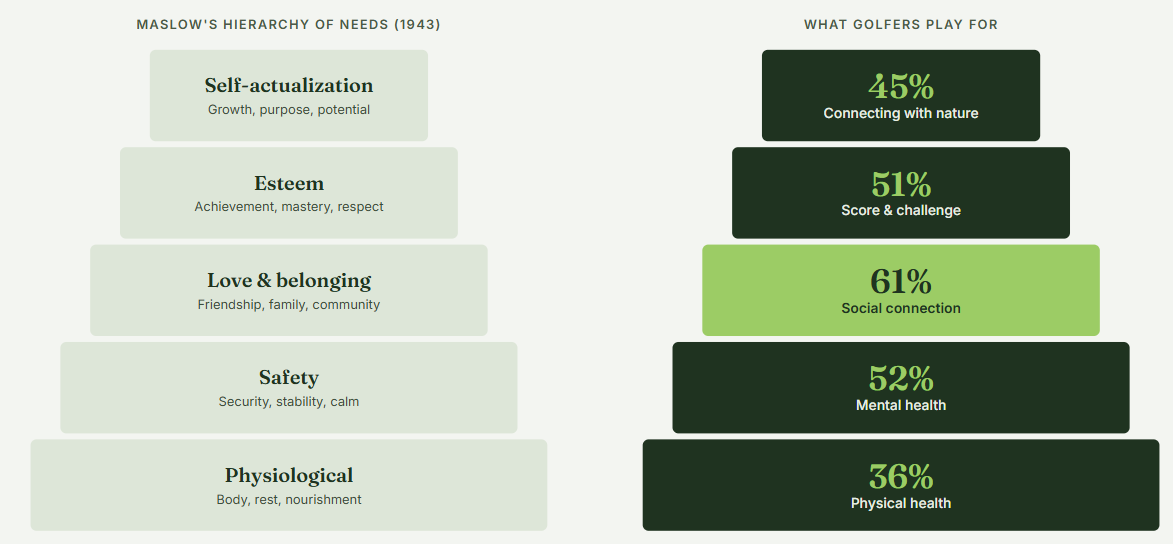
True Well-Being among humans can be described by our concepts of Human, Social, and Cultural Wealth (“Wealth” = Wellness and Health). One primary study from Driving the Green revealed that golfers’ core needs are relational and developmental rather than superficial (success, status, goal-attainment, et cetera).
We designed a simple question with Maslow’s “Hierarchy of Needs” in mind:
Why do you play golf? (select up to 3)
Here were the findings (top needs in order):
1. Connection with friends and loved ones (61%)
2. Improving mental health / reducing stress (52%)
3. Challenging myself to improve score/handicap (51%)
4. Connection with nature / enjoying the elements (45%)
5. Improving physical health / staying in shape (36%)
From this awareness, we have developed the Five Connections of Regenerative Being, which is Driving the Green’s contribution to the culture of golf, described in greater detail in following sections.
For a simpler introduction, how does reconnection resolve separateness and lack?
Through the Five Connections of:
Awareness (Mind and Psyche)
Fitness (Embodiment and Physical Health)
Relatedness (Heart-Centered Living and Relationships)
Wilderness (Nature)
Wholeness (Being-in-Flow and Living with Integrity)
With that preamble, here are the Five Connections in greater detail, along with ideas for how the game of golf can lead humanity into greater Awareness, Fitness, Relatedness, Wilderness, and Wholeness.
Awareness
(Mind and Psyche)
If you can notice that you are thinking, then what is the part of you that is capable of noticing? Awareness. Awareness is therefore a part of our conscious being that exists beyond thought. For a human being to be a true “wise being” and not just a “thinking man”, the human being must develop awareness. When awareness takes you beyond your thoughts, then you have the power to shape them. Shape your thoughts, shape your outcomes (like a golf shot), and ultimately, shape your life.
Golfing great Bobby Jones once said that “golf is a game that is played on a five-and-a-half-inch course – the distance between your ears”. He was the co-architect of Augusta National, famous venue of golf’s annual Masters Tournament, and Bobby Jones knew that mastery of mind was foundational to success in golf and life.
If we continue through the minds of golf’s “Mount Rushmore” (so to speak), we can see a clear pattern:
“Golf is deceptively simple and endlessly complicated; it satisfies the soul and frustrates the intellect. It is at the same time rewarding and maddening – and it is without a doubt the greatest game mankind has ever invented." – Arnold Palmer
“Golf is a great mirror, often revealing things about you that even you didn’t know. It cannot be misled. Still we try.” – Tiger Woods
“If there’s one thing golf demands above all else, it’s honesty.” – Jack Nicklaus
Jack Nicklaus, the most winning golfer in professional golf history, began Part One of his famous Golf My Way book with over 50 pages on Awareness, or what he calls “Beliefs and Attitudes”. If you play to keep score, or at least play by consistent rules, then your golf game will tell you almost everything you need to know about your life. It will reflect your habits, beliefs, and alignment (or lack thereof, as a mind ruminating on its separateness, for example). Golf will eventually reward your mind for practicing presence and gratitude, and if your mind is rejecting present reality or if it is stuck in the past or future, then golf may course-correct your mind.
In most cases, when you pour attention, passion, and presence into something, then it will inevitably mirror the deeper parts of you. As evidenced by a long literature on the topic, Golf invites a deeper level of presence and a deeper level of awareness to those who invest attention in its mysteries. Check out these recommended readings on golf psychology:
Golf in the Kingdom by Michael Murphy
Golf My Way by Jack Nicklaus
How I Play Golf by Tiger Woods
Golf is My Game by Bobby Jones
Five Lessons by Ben Hogan
Golf is Not a Game of Perfect by Dr. Bob Rotella
Conscious Golf by Dr. Gay Hendricks
The Inner Game of Golf by Timothy Gallwey
Zen Golf by Dr. Joseph Parent
The Mindful Golfer by Steven Altschuler
Swing Like You Don’t Care by Arnie Kozak
Golf for Enlightenment: The Seven Lessons for the Game of Life by Deepak Chopra
Fitness
(Embodiment and Physical Health)
The concept of “survival of the fittest” (commonly attributed to Darwinism along with the theories of evolution and natural selection) never meant that the strongest, fastest, and biggest are guaranteed to survive and thrive. “Fittest” rather refers to what attributes make an organism, species, or participant of life “fit” for its environment.
What physical (and psychological) attributes does golf call forth from its players?
Presence
Patience
Alignment
Sensitivity
Balance
Mobility
Coordination
Golf is a physical embodiment practice of life’s deepest lessons. Those who became golf’s greatest (and who gave their prime years to the sport) also came away with profound lessons. Through years of competitive evolution and technological advancements, modern professional golfers are hitting the ball further distances than ever, such that being fit to compete in golf now more than ever also requires being an athlete.
Probably 99.9% of golfers will never earn money competing in the sport and do not need to gain massive clubhead speed or prove strength through their golf game. However, playing and improving at golf as a sport still requires dedicated concentration of awareness into the body, and for the mind and body to coordinate as one.
Ultimately, although the highest levels of golf as a competitive sport can require athleticism, the game of golf (what we call the “game of a lifetime”) is fundamentally a mind-body practice.
The body is the mind. The peripheral nervous system and central nervous system are inseparable, and the intuition of the body (or unconscious mind) connects us to a wisdom beyond the conscious mind. Golf is not only a sport, but a mind-body practice of embodying deeper life lessons of integrity, alignment, rootedness, humility, surrender, confidence, clarity, and commitment, to name a few.
How do we cultivate embodiment that is “fit” for the modern world? Physical life expectancy markers have gone up among most populations around the world, though psychological (quality of life) markers have declined over the past half century, while chronic disease has also trended awry.
The mental health of younger generations has particularly suffered amidst a pandemic of distractions in a digital world that looks to split, shorten, and monetize attention spans. Where can golf come in? Golf requires total concentration of attention into the present moment through the physical body, and it can do so while reconnecting participants to nature, their loved ones, and the deepest parts of themselves.
From a standpoint of modern fitness in a world where distraction (dis-traction, or “pulling apart”) is the greatest threat to quality of life, golf requires its participants to become rooted in the real. Playing golf as a regenerative mind-body integration practice represents not only hand-eye coordination, but head-hand-heart coordination.
Relatedness
(Heart-Centered Living and Relationships)
Relationships are what give life its meaning (and even what we refer to as “oneself” is ultimately composed of relationships among parts).
A Harvard study looked at the keys to happiness and longevity over the course of nearly a Century (Harvard Study of Adult Development - a longitudinal study starting in 1938).
The study found that happy relationships are the key to health and happiness. More than money, fame, social class, IQ, or even genetics – and even after controlling for some of those factors – having strong connections with family, friends, and community are the ultimate predictors of health outcomes and long-term happiness. The same study also concluded that loneliness and stress are as bad for your health as smoking cigarettes.
Golf is supposedly a solo sport (and a pure one at that – you and your scorecard). However, our data suggest that relatedness is a golfer’s greatest expressed need. This might explain the surge of off-course participation in recent years (through formats like Topgolf, Drive Shack, and PopStroke that invite casual beginners to socialize while they try golf), which has helped drive increases in on-course participation. Culturally, golf brought relatedness in the era of “social distancing”, which led to a huge rise in golf participation.
The ultimate images of championship golf aren’t about the trophies, but the acknowledgements of coaches, parents, significant others, children, past champions, and the fans. Competition is set within a greater backdrop of total cooperation, and even the greatest competitors are often those with clear priorities. See this quote from Scottie Scheffler (on faith and family over fame):
“It feels like you work your whole life to celebrate winning a tournament for like a few minutes... and then it's like, okay, now what are we going to eat for dinner? You know, life goes on … It’s fulfilling from the sense of accomplishment, but it's not fulfilling from a sense of like the deepest places of your heart.” – Scottie Scheffler
Who wins the most in the modern era of competitive golf (in both happiness and trophies)? One who is heart-centered in strong relationships.
See TED Talk: What Makes a Good Life? Lessons from the Longest Study on Happiness
Wilderness
(Nature)
Since its beginning in 2020, Driving the Green has been publishing stories that bring awareness, hope, and practical guidance toward building a better world in and through golf via nature-based solutions.
Nature is alive within us and around us, it is constantly changing, and it is perfectly imperfect, just as we are. To be alive and outdoors, and playing golf at all is an undeniable miracle. Recognizing that miracle can bring us back into gratitude for Being, while revitalizing a sense of faith in life.
We come from the same source, whether that’s atoms and energy in a material universe or from God; “Being” can describe either concept (whichever floats your boat). The natural world reveals higher levels of order and intelligent design beyond the human mind.
Exposure to the elements of nature has an ability to reconnect us with a deeper sense of safety. When the mind feels safe (such as at a golf course), then the need for that survival mechanism goes away, the illusion of separateness dissolves into awareness, and the flow state can unfold (losing sense of time and self, merging with the moment, and probably playing much “better” golf as a result).
In one sense, the mind is a powerful tool: the spearhead of 3.8 billion years of evolution throughout which we were fighting pathogens, predators, and one another. The self-separating mind is an antiquated phenomenon in most modern contexts of safety; so much so that it is creating unsafety, self-harm, and ultimately planetary harm. That need not be the case, and golf can lead planetary stewardship through appreciation and alignment with nature. It’s less so that nature needs us to “save the planet”; more so that we need nature.
A regenerative golf course can be a place of rich natural wealth, particularly when it invests in nature-based solutions and creates ecosystem services. The conventional golf course nevertheless raises real estate value because we intrinsically value open green space. People want to live on golf courses because we inherently long for reunion with nature, which is crucial for mental and physical well-being.
Wholeness
(Being-in-Flow and Living with Integrity)
Wholeness is the integration of other 4 connections, culminating into Well-Being for All. It is the integration between parts composing a greater unity. Wholeness means putting it all into practice, and practice makes mastery.
Each connection on its own offers some gateway into Wholeness. Regenerative Golf offers space for each of those Five Connections:
Awareness – Being alive and fully present reveals that we are greater than our thoughts, and the ego is an illusion predicated on separateness.
Practical Examples of Awareness through Regenerative Golf:
Deep breaths at the first tee… and every tee (Healing Systems (and Self) through Golf)
A scorecard prompt: “Which shot were you most present for?”
Treat temper as practice material (A Psychoanalysis of Happy Gilmore)
Superintendents observe before they treat (Engineering, Intuition, and the Future of Turf)
Mental health and self-awareness clinics
Book clubs (see the suggestions above)
Phone-free twilight nines
Meditation, breathwork, and yoga collaborations (local studios/teachers)
Host retreats and events for self-development and Regenerative Leadership
Fitness – Strong, isolated muscles don’t make the ball go far, but rather the coordination of muscle groups in coordination with the greater whole.
Practical Examples of Fitness through Regenerative Golf
Fitness challenges to encourage activities
Alternative formats of golf (speed golf, foot golf, etc.)
Cross-promotions with other local mind-body businesses
Walking rates and push-cart fleets
Mobility screens at the range
Heat and safety protocols for the crew
Relatedness – Relationships test the limits of the ego, require healthy boundaries, and require awareness outside of one’s limited mind, but the conscious flow of giving and receiving expands the heart. When two people whole within themselves meet one another in relationship, they can form an even greater whole that is greater than the sum of the parts. So it goes for communities, organizations, and beyond.
Practical Examples of Relatedness through Regenerative Golf
The course as a community hub (Golf as an Integral Community Space)
“Bring a first-timer” days (Advancing Gender Equity in Golf)
Design short, walkable loops that encourage social life (Gateway Golf)
Community golf partnerships (California Community Golf Summit)
Members meet the crew by name
Community gatherings
Potluck dinners
Night life through lit up golf
Date nights, singles nights
Wilderness – Going into nature (or being on naturalized land) reveals that nature is composed of interdependent relationships, unity, and ultimately cooperation. Because we are a part of (and not apart from) nature, contributing to ecosystem health contributes to humanity’s health. Spending time in nature also make individuals healthier and happier.
Practical Examples of Wilderness through Regenerative Golf
Habitat restoration projects
Invest in Natural Capital to measurably regenerate SWALE (Soil, Water, Air, Life, Energy)
Soil-first turf care (Regenerative Turf)
Grazing and native areas (Goats at Rock Creek Park Golf)
The course as a water filter (Golf Course as a Living Bio-Filter)
Nature walks and bird counts (Golf’s Status as a Living Classroom)
Firm, fast conditions as the natural game (What’s Under the Green)
Barefoot golf outings (Earthing)
Wholeness is Being-in-Flow. The state of “flow” is fundamentally healing, and Regenerative Golf can provide the conditions for flow.
Flow is a remembrance of the part back to the greater whole, and when control is surrendered in golf swing mechanics (or rather alignment to the “whole” is fully trusted), then attainment happens naturally. That awareness therefore makes us better golfers, but what can it say more broadly about life and being in alignment with the whole of life?
“Ego” is the forgetfulness and mental resistance against Being; Mental dis-ease takes us out of alignment, and surrendering into the whole naturally brings us back toward alignment with nature, life, and our deepest needs.
A truly “wealthy” human is “affluent” (in flow). Get lost in flow, and gain it all.
How can golf then contribute to a world of universal affluence? By helping people lose themselves and gain the greater whole, and teaching Attainment through Alignment. Through the seeds of intention and attention, let's plant wisdom as the perennial crop of golf, so that its players and operators live at the level of consciousness needed to address humanity’s most pressing needs of the modern world.