What's Under the Green: The Soil Science Behind Regenerative Golf
Co-Authored by:
Dr. James Friedericks, Director of Lab Quality and Research
Garret Johns, Agronomic Support Specialist
Edited by Andre Paul, Co-Founder of Driving the Green

What’s Under the Green?
Golfers read greens. They crouch behind the ball, study the slope, and trust their eyes. Superintendents do something similar, just six inches lower: they read soil. What's happening down there decides a lot more than most players realize: how firm the fairway plays in August, how much water a course needs in a dry July, and whether the ninth green is still standing up to traffic in year twenty. For owners and operators, that last part is the one worth sitting with. A course that understands its soil is a course that spends less to keep conditions consistent, recovers faster from a stressful season, and has real data to point to when the budget conversation turns to irrigation or renovation.
Soil is a living biological system, not just a growing medium. The organisms working in the root zone (fungi, bacteria, and other microbes breaking down organic matter and cycling nutrients) are what make water, air, and plant life possible in the first place. This approach points to something practical. Regenerative golf management isn't only a mindset shift; it's a matter of measurement.
A course can't regenerate a biological system it doesn't first understand.
The Ground Truth
“Regenerative Golf” develops from a set of decisions a course can actually track over time. Soil data, across its chemical, physical, and biological components, is what makes that tracking possible. AgSource has spent years running exactly this kind of testing for courses around the world, and we work directly with superintendents on soil, soil health, plant tissue, and irrigation water testing. For any course creating its own regenerative roadmap, a soil health test is a reasonable place to put the first stake in the ground.
What "Healthy Soil" Actually Means
Soil health can be broken down into three interwoven components; each being measured differently. The chemical, physical, and biological components are all necessary for a thriving soil system:
Chemical: The chemical side is what most superintendents already test for: pH and buffer pH, nutrient reserves like phosphorus, potassium, calcium, and magnesium, and cation exchange capacity (CEC), which describes how well soil retains nutrients instead of letting them wash away.
Physical: The physical side covers structure and water-holding capacity, how much of an August rain actually stays available to the plant instead of running off or draining past the root zone.
Biological: The biological side is the newest piece for many operations: the living organisms and organic matter that cycle nutrients and hold the whole system together. Organic matter works almost like a savings account, storing nutrients and water for later use while feeding the biology that keeps soil structure loose and workable.
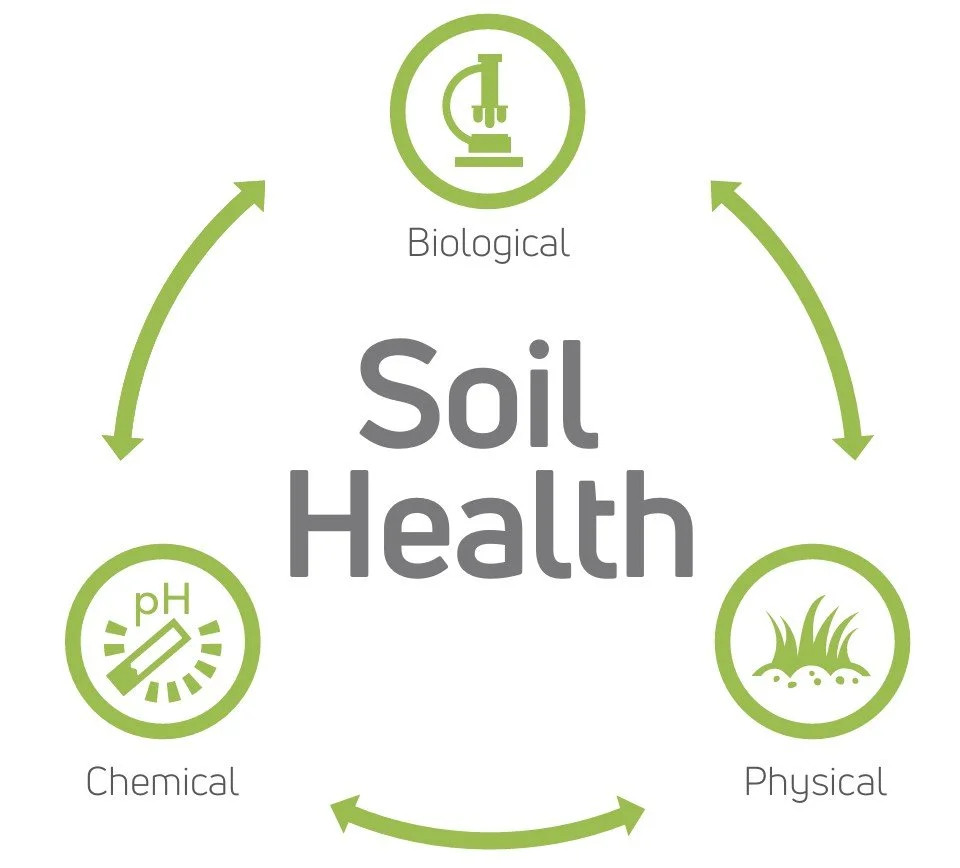
It's hard to gauge any of these components just by looking at a golf course, hence the importance of soil testing.
It’s important to remember that greens and fairways often need to be read differently. Greens are typically sand-based and more intensively managed, so their chemistry and biology can look very different from a fairway's more native soil. Testing each separately and knowing how to interpret what the numbers mean for that specific surface is where a course's testing partner earns its keep.
Check out AgSource’s on-demand webinar, Managing Soil Health for Better Turf, to dig deeper into the elements of soil health and see practical ways to apply results on your course.
Testing, Not Guessing
A blanket fertility or irrigation program treats every green and fairway the same, even though soil chemistry can shift significantly across eighteen holes. Testing treats each site as its own living system with its own nutrient reserves, its own structure, and its own history.
That distinction matters for the regenerative case specifically. Inputs applied where they're not needed aren't neutral — they're waste, often in the form of runoff. A soil test turns "apply fertilizer" into "apply exactly this much phosphorus to this green, and skip it on that one." Driving the Green recommends similar sequencing for any course starting its regenerative transition: understand the baseline before spending on the bigger moves (diagnostic-first).
Soil Health Is Conservation
Beyond the chemical picture, soil health testing measures the biological side directly. It looks at the potential rate of biological activity in a sample and the levels of carbon and nitrogen that control that rate. A soil health test returns a score tied to those characteristics. A higher number indicates a more biologically active, healthier soil; a lower number the opposite. That score becomes a reference point, a way to gauge a course's current soil quality and track whether steps like biochar applications, reduced inputs, or naturalizing the golf course is actually improving soil health over time, not just assumed to be.
Biological activity has a direct line to conservation. Healthy, organic-matter-rich soil holds more water, which means less reliance on the irrigation system and, by extension, less pressure on the watershed a course draws from. Well-structured soil also acts as a natural filter. Water moving through healthy turf and soil can leave a course cleaner than it arrived, instead of carrying nutrients and sediment downstream.
Soil Health Is Playability
This is the part that reaches the golfer directly, even if they never see a lab report. Deeper, healthier root systems produce firmer, more consistent turf that recovers faster from drought stress, heavy traffic, or a hard rain event. The same qualities that make a course play firm and true are the ones built from the ground up through soil biology.
Regenerative and championship-quality conditions aren't in tension. A golf course that manages its soil well also holds its conditioning together the longest into a dry stretch while bouncing back the fastest from stressful conditions.
Where to Start
The practical entry point is simple: a baseline soil test (chemical) paired with a soil health test (biological), followed by in-season plant tissue testing to track nutrient status as conditions change, and irrigation water testing to complete the picture. None of this requires a major capital project. It's the low-cost diagnostic work that funds and informs everything that comes after.
Ready to get started? Learn more here: Turf Soil Analysis
Resources and Images:
Soil-Health-Three-Components-of-Soil-Health-Tech-Bulletin_F-2635845593-TURF.pdf
Soil-Health-Understanding-Soil-Health-for-Turf-Tech-Bulletin_F-2635706875-TURF.pdf
About the Authors:
Garret Johns (LinkedIn Profile) is an Agronomic Support Specialist at AgSource, where he works as a technical specialist for clients, translating soil and tissue data into practical decisions. He has a strong background in soil and plant health and before joining AgSource he helped build and run tissue sampling, grid soil sampling, and well-water testing programs at a large cooperative. His work has since expanded to include expertise in turf and soilless media testing. Garret works with clients at every level of experience, from first-time customers new to soil sampling to managers around the world always leveraging the power of data to drive informed decision making.
Dr. Jim Friedericks is Director of Laboratory Quality & Research at AgSource, where he leads initiatives focused on analytical quality, research, and the development of new testing capabilities across the organization’s agronomy laboratories. With more than 35 years of experience in soil and environmental science, he holds a Ph.D. from Virginia Tech and has worked as a laboratory technician, supervisor, manager, and university professor, including more than a decade teaching in Kenya and Tanzania.