Golf as a Regenerative Business
Golf as a Regenerative Business:
The Five Wealths Framework for Compounding Value
A Pulse Check for Golf
By most measures of financial health & well-being, golf is having its best run in twenty years.
Participation is at an all-time high. The National Golf Foundation's 2026 Graffis Report documents another net increase of a million on-course participants, with total participation at its highest level ever. 48.1 million Americans played golf on- or off-course in 2025.
Rounds keep setting records (on a smaller footprint). 2025 delivered record rounds-played for the fourth time in five years, achieved with roughly 2,000 fewer facilities than existed at the participation peak two decades ago.
Supply has stabilized after a twenty-year correction. NGF reports course closures at their lowest counts since 2004, more than 140 new courses in planning or under construction at the start of 2026.
Operators have real pricing power (and they’re reinvesting it in capital improvements). Public 18-hole green fees have risen 29% over seven years against 27% inflation, while the NGCOA's 2026 Golf Business Pulse Report finds owners pouring profits back into upgrading their courses.
The player base is broader than it has ever been. More than 8 million women and girls now play on course, which is an all-time high and a 46% increase over 2019. Golf has much room to grow, but also reports growing diversity across the participation base.
Superintendents/maintenance are delivering on efficiency. U.S. golf facilities used 31% less water in 2024 than in 2005, according to GCSAA's Golf Course Environmental Profile.
This all probably sounds familiar if you own or operate a golf facility, so here is the question worth sitting with:
What, exactly, are you converting your successes into? What is ultimate success for a golf course?
Five Forms of Wealth
When I attended the Sustainable Innovation MBA program at the University of Vermont in 2018, one of the first innovators to shape my thinking was Hunter Lovins, co-founder of Natural Capital Solutions. She brought our cohort's attention to the concept of capital itself, but also how it reveals the incomplete logic of capital-ism (which has been an effective system for the wrong purposes).
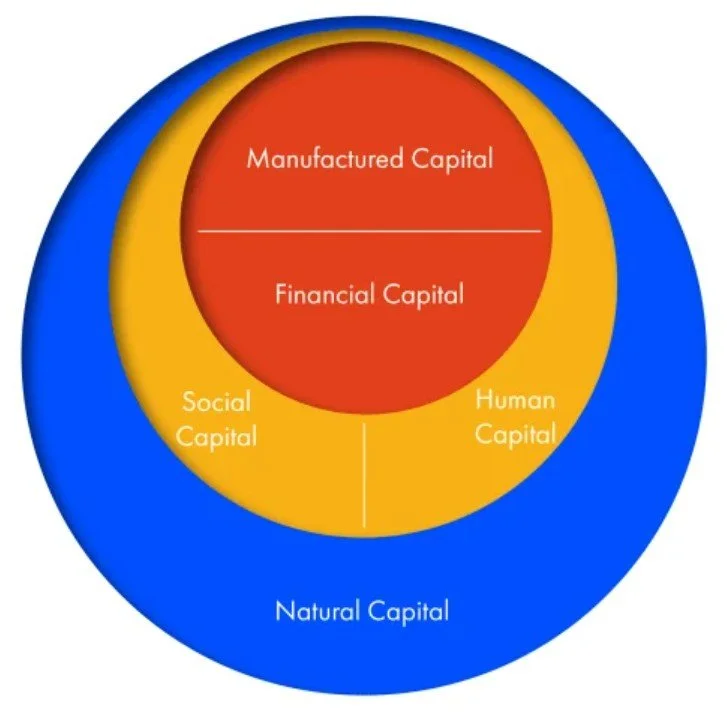
Completing that logic is the Five Capitals model. It says something simple and structurally important: traditional capital (cash, stocks, fixed assets, etc) is built by the human and social capital of people working together, who in turn depend entirely on the health of natural systems. The relationship is nested, not parallel (particularly for golf courses). Your P&L sits inside your community, which sits inside your watershed.
See the graphic below for a visual of the Five Capitals framework:
The BE³ Framework
At Driving the Green, we adapt this into the Business–Economics leg of our BE³ framework as five interconnected forms of wealth. We chose that word deliberately, to call on the health and well-being of five living systems rather than the cold inventory of "capital." Living systems differ from traditional capital in that they comprise stocks, flows, and feedback loops that affect growth (along with “leverage points” or ways to intervene in those systems that yield broader impacts).
Financial Wealth: stocks of money and financial resources; flows of economic value.
Natural Wealth: stocks of natural resources; flows of ecosystem services.
Human Wealth: stocks of skill, knowledge, and wisdom; flows of human gifts.
Social Wealth: stocks of trust and shared values; flows of symbiotic relationships.
Cultural Wealth: stocks of legacy and identity; flows of stories.
Three things are true of all five:
Each holds a stock and produces a flow,
Each can be built or spent; and
Each converts into the others (via process loops or cycles)
Healthy soil converts into lower input costs. A retained superintendent converts into fewer emergencies. Community trust converts into political safety when the water gets tight. Only the first of the five appears on your balance sheet (e.g., input costs), but all five should thrive for long-term operational sustainability.
Golf's financial wealth is at a twenty-year high. Its other four wealths remain as underleveraged intervention points for the health of the industry, the game, and the planet. Operators are more stressed rather than less. The typical operating model still sees a wrestling match between financial costs along with the biology that golf courses depend upon. Part of golf's record financial performance is from real value creation, while part of it is borrowed from capital that does not fit traditional accounting logic. The environmental movement still treats golf as an adversary (at worst), and a game requiring severe biological trade-offs (at best). Environmental trade-offs aside, enormous human potential remains untapped in both the player market and the workforce of golf.
Regenerative Golf is the discipline of compounding all five forms of wealth together, which is what allows golf to thrive not only for two decades, but for the next two centuries and millennia to come.
The Scorecard: Can Golf Become a Measurably Regenerative Business? How is it currently performing in the five areas of wealth creation?
Financial Wealth (thriving, but driven by macroeconomic luck?)
This is the account golf has learned to manage well. Revenue per round is up, capital is flowing back into the product, and more than half of facilities report significant course or clubhouse investment in recent years.
It is also the account that makes everything else possible. Even a business with the best intentions cannot survive without profiting, or at minimum financing its expenses. No money, no mission. Nothing in regenerative business asks you to trade this away.
But note the shape of the growth. SLRG's Jon Last, who produces the NGCOA Pulse Report, describes golf benefiting from a K-shaped economy where success remains hyper-local, with stresses showing at the bottom of the market. Owners are growing increasingly worried the game is becoming too pricey for the average golfer. Premium courses charging above $80 have grown 40% since 2019. Financial wealth is accumulating at the top, not distributing across all segments of golf. Gains in net participation were largely driven by the pandemic, while player retention still remains a challenge for the culture of golf (amidst an increasing landscape of consumer options for recreation and entertainment).
Natural Wealth (Eco-efficiency has its limits.)
A 31% water reduction from 2005 to 2024 (reported in the US) is a genuine achievement, and superintendents deserve the credit. Reading those same GCSAA data more closely: the reduction since 2020 is 3.2%, and roughly two-thirds of the total came from applying water more efficiently (better nozzles, smarter controllers, precision scheduling). In regenerative terminology, this equates to achieving “less bad” solutions rather than proactively building ecosystem services across the industry. We can do more.
Twenty years of effort bought 31%. The last four bought 3.2%.
That is what a maturing lever looks like. Golf has become extraordinarily good at delivering inputs precisely into a system whose underlying demand has not changed. The remaining upside is not in the sprinkler. It is in the soil, first: organic matter, microbial life, infiltration, and rooting depth that reduce what the system needs in the first place. That is the entire premise of our SWALE lens (Soil, Water, Air, Life, Energy).
The stakes are not merely abstract. A PwC analysis puts 55% of global GDP (roughly $58 trillion) as moderately or highly dependent on nature, and a 1997 paper in Nature that has since been cited more than 17,000 times valued the world's ecosystem services in the tens of trillions annually. Golf is one of the most dependent sectors or industries with respect to nature, so golf has an opportunity to leverage its financial success (Financial Wealth) and cultural positioning within business (Cultural Wealth) to become a recognized leader in regenerative economics. No Nature, no economy.
Human Wealth (Labor markets are revealing what the balance sheet cannot.)
A superintendent with more than thirty years in the profession wrote recently about a role that has become one of the most versatile in the industry: plant scientist, soil scientist, meteorologist, mechanic, budget manager, HR lead, project manager, all before the first group goes off. His sharpest observation is an accounting problem: in this profession, success is measured largely by what never happens. The disease that never appeared. The pump station failure golfers never noticed. The tournament that ran flawlessly through a bad week.
Conventional accounting records transactions. It cannot record avoided losses. Which means the single most valuable thing a great superintendent produces is structurally invisible to the system that decides his budget.
The labor market, however, isn’t fooled. GCSAA data shows average superintendent compensation reaching $121,238, up 10.6% in two years and outpacing the 8.1% national average, with certified superintendents at $138,303. The average superintendent is 47 years old with nearly 16 years of experience, meaning they have a decade and a half of site-specific knowledge that exists nowhere but in one person's head.
Meanwhile the NGCOA and NGF's 2026 Compensation & Benefits Report found 66% of responding facilities offering health insurance (94% at private clubs, but only 58% at public courses). The bottom of the K is where human wealth is thinnest. No people, no product.
Social Wealth (Retention = relationship-building.)
Over 21 million Americans did not play golf in 2025 but told the NGF they are "very interested". That pool up 37% since 2019, nearly half of them lapsed golfers who have already played your product once. And roughly two-thirds of green-grass beginners now enter the game through off-course experience first.
To greengrass golf business owners: the top of your funnel is no longer inside your property line. It runs through simulators, entertainment venues, junior programs, municipal courses, and the people who introduce a friend to the game. My personal introduction to the game as a kid came from miniature golf and playing the Tiger Woods video game, so I can attest to that even before the boom of off-course golf!
Off-course venues are relational infrastructure that you benefit from but do not own. If Financial Wealth permits, then think about developing on-site versions of “gateway golf” experiences that invite beginner golfers to view the game through a welcoming social lens.
Cultural Wealth (Diversity? Improving. Biodiversity? Stalling.)
Golf's cultural stock has genuinely risen. NGF finds public perception increasingly aligned with being social, healthy, welcoming and fun, and the participation base is the most diverse in the sport's history.
But that gain has come almost entirely on one axis. On ecology, the industry still takes a defensive posture. How will defense hold up when the water usage of data centers comes under increasing scrutiny and then fingers point back to golf as an even bigger user of water?
Industries do not build advocacy machinery for problems they do not have.
GCSAA has funded the Golf Course Environmental Profile since 2005 and built a national Best Management Practices advocacy program around it. You can also read the industry’s environmental position in land more broadly. NGF's framing is that sometimes "the dirt is worth more than the grass", and the organization expects closures to keep outpacing new openings given demand for residential and commercial land near cities. When a community would rather have almost anything else on the parcel, that is a cultural verdict expressed in dollars.
Culture also arrives as a hard cost. Televised tournament conditions and instant social comparison have set a maintenance standard your budget has to fund. While this is somewhat out of the operator’s control, reframing golfer expectations toward firm, fast, ecologically legible conditions is not an environmental initiative but rather a cost intervention. With respect to Culture and Nature, it’s time for golf to create and tell the stories that highlight opportunities for industry growth through “going on the offense” instead of defense (Driving the Green instead of laying up). Regenerative strategies and framing will show position golf as a leader of broader culture.
Golf Operators Are Already Experts at Converting Wealth Across Disciplines
Here is the mechanism at the center of all of this, and the part I most want operators to take away: Wealth converts, and it always has. The question is not whether you are converting one form into another, it is whether you are doing it consciously and how you can do it better.
A deferred aeration converts natural wealth into this quarter's margin. Overworking superintendents converts human wealth into meeting golfers’ impossible course expectations. A rate increase that prices out the local municipal player converts social and cultural wealth into revenue per round. Every one of those conversions shows up immediately on the P&L as good management, but extractive logic hurts the whole.
But the engine runs both directions, and that is the opportunity (mutually-reinforcing wealth creation):
Soil organic matter converts into lower water and input costs, season after season. A superintendent who stays converts into fewer emergencies, better vendor pricing, and institutional memory that cannot be hired. Community trust converts into water security, faster permitting, and political strength. A course with a genuine story converts into membership demand that does not require discounting. In fact, this is true of any golf brand.
During my time at the National Golf Foundation, I watched this play out from the inside. Some of the smartest owners of capital in golf were also the ones most dedicated to the health of the whole sport by proactively investing in player participation, customer experience, and the health of the game itself. That wasn’t simple charity. It was the understanding of sophisticated golf brands that financial return in golf is downstream of things that never appear in a financial statement.
Two Quarters, Two Decades, or Two Centuries?
A short-term focus on financial capital alone plateaus. Every lever golf is currently pulling has a visible ceiling, thus the time is ripe for transformation and sustainable innovation.
The demographic tailwind of the “boomer influx” has a published expiration date (Boomers turn 65 at 10,000 per day only through 2029). The efficiency lever is flattening, as the water data shows. Pricing power ends where affordability begins, which is precisely what owners told the NGCOA they are worried about.
In Regenerative Golf, the five wealths behave differently. They are the only inputs in a golf business that get cheaper and/or more productive the longer you invest in them, because each one lowers the cost of building the next. Healthy soil reduces the crisis load on your crew. A stable crew produces better conditions at lower cost. Better conditions and a real story earn community goodwill. Goodwill protects your water, your zoning, and your land. Committed stewardship of that land ultimately affects stakeholders far beyond the game’s participants.
Golf is uniquely positioned for this type of holistic compounding growth.
It is worth being precise about the three postures available here. Traditional business builds financial wealth without adequately valuing the rest. Sustainable business works to mitigate harm, or to become "harm-less." Regenerative business starts from a different question entirely: how can this enterprise be help-full? How do we design a facility where the five wealths build one another rather than cannibalize one another?
Golf's asset is a living system. Soil takes decades to build and a single season to degrade. A club culture takes a generation. The businesses that not only survive quarters but thrive for centuries will be the ones whose accounting goes beyond linear logic, and toward holistic accountability.
One Question for the Journey of a Lifetime
Some years ago I heard Jeffrey Hollender pose a question that originates with Regenerative Business author Carol Sanford:
"What does the world most need that you are uniquely positioned to provide?"
I answered it as literally as I could, and it led me to search the words "regenerative golf" before activating seven years of this work (and many decades to continue). Time spent with regenerative leadership coach Giles Hutchins clarified something I had been circling: the take-make-waste logic of conventional business comes from a mind that experiences itself as separate from nature. Regenerative business is what becomes possible when that separation closes. That is the Being–Essence leg of BE³, and it deserves its own article on how change requires being the change we want to see (while solving problems from a level of thinking that transcends the mindsets that created those same problems).
For now, consider this prompt for reflection:
What does your community most need that your golf course is uniquely positioned to provide?
Golf course operators already hold the answer in five accounts of wealth.
Driving the Green helps golf businesses build all five forms of wealth. Start with a free Regenerative Rangefinder assessment of your facility, or reach out about a project inquiry.