
Regenerative Air Management (SWALE Series)
Can golf go under par on the carbon scorecard?
With as much attention as golf receives for its use of water, land, and other resources, what does it look like for a golf course to practice regenerative air management?
Golfers might not commonly think about golf courses as landscapes that “breathe,” but operators manage that exchange every day: drainage, soil infiltration, organic matter content, volumetric water, soil oxygen and nutrient cycling determine whether turf roots can function and whether the surface stays playable. Above the surface, the same property is trading carbon and nitrogen with the atmosphere through its interchange of mowers, fertilizers, trees, and the soil food web.
For the purposes of our SWALE framework, we can think of “Air” as the exchange between the landscape and the atmosphere required to support ecological function while providing a playable golf course. That includes carbon dioxide moving into plants and soils. It also includes greenhouse gases leaving the system through fuel combustion, electricity demand, fertilizer production and nitrous oxide emissions from soil.
In other words, a golf course has both sources and sinks. The regenerative question is whether we can engineer those two sides of the equation so the landscape ultimately stores more atmospheric carbon than operating the golf course releases.
Furthermore, can we do it without giving up the playability that keeps the land in golf in the first place?
Regenerative air management is about managing a course's nutrient (and specifically gas) exchanges without compromising the playability that keeps the land in golf. Management practices aim to get nutrients into the rootzone below ground while moving the property toward net carbon storage (through roots and biomass).
Revisiting Our “Real Zero” Article
In late 2022, Driving the Green published Can Golf Courses Achieve a “Real Zero” Carbon Footprint?, which asked whether the photosynthetic capacity of a golf landscape could offset the emissions required to operate it. The framing came from NextEra Energy's Real Zero commitment: eliminating Scope 1 and Scope 2 emissions outright rather than buying offsets. We argued golf could pursue the same logic, helped along by falling renewable costs and the climate provisions of the Inflation Reduction Act.
The core argument still holds, but the science has developed along with the accounting, and so has the policy environment (though in a direction we did not anticipate).
NextEra has reportedly stepped back from Real Zero (among a trend of many corporations rolling back sustainability commitments amidst a hostile political climate). Reporting in 2026 indicates the company told investors it no longer saw a realistic path to its 2045 goal, dropped its interim targets, and has framed itself through energy abundance and a diverse energy mix.
The federal incentives we cited have been curtailed. The 2025 tax law accelerated the termination of clean electricity credits for solar and wind and rescinded the climate-specific guardrails on conservation program funding (which originated from the Biden Administration).
The research base improved substantially. That means we no longer have to rely on proprietary calculators for our numbers and can operate from robustly researched carbon accounting ranges.
The first two developments are the more instructive ones. A corporate pledge can be withdrawn in a single investor update, and a tax credit can be repealed by one act of Congress. A wetland that stays wet and a buffer that keeps growing do not depend on anyone's continued enthusiasm. If anything, this strengthens the case for focusing on practices that pay for themselves with clear ROI, because those are the ones that survive a subsidy rollback while also contributing toward Regenerative Business.
We are also retiring two numbers from that article. We cited a proprietary calculator suggesting a typical course draws down 50 tons of carbon while netting 20.6 tons of CO₂ emissions. Those figures mixed units of carbon and carbon dioxide, and they sit well below what the peer-reviewed literature has since established.
Here is what the latest published work really says!
How is Golf Doing on the Carbon Scorecard?
The strongest golf-specific lifecycle study we missed the first time comes from Michael Bekken and Douglas Soldat, published in the International Turfgrass Society Research Journal in 2021, which built a model of maintenance energy use and emissions and applied it to 14 golf courses in the northern United States over three years. Among the four courses with complete Scope 1, 2 and 3 inventories, maintenance averaged 4.28 metric tons CO₂e per hectare per year, or about 1.73 tons per acre. The mean absolute maintenance footprint was approximately 153 metric tons CO₂e per course per year, which is the equivalent of about 33 passenger vehicles, using EPA figures. Fuel and electricity represented 63% of those emissions. The remainder came from fertilizer production and soil emissions, sand production and transport, pesticides, machinery and other upstream inputs.
That leads to a conclusion worth stating plainly: decarbonizing golf is not simply a soil-carbon project. It involves a multi-disciplinary effort to change management of energy, fertilizers, irrigation, materials and a land design at the same time. It requires new paradigms that serve best at the outset of design thinking.
Two caveats belong alongside the headline number:
All 14 courses supplied Scope 1 data, but only seven supplied Scope 2, seven supplied Scope 3, and just four supplied all three, so the all-scope mean rests on a small subsample.
The sample is regionally concentrated in a cool-season climate, against a global population of more than 38,000 courses. It is the best benchmark available, not the last word.
Maintenance Does Not Include the Whole Facility
Katrina Gillette's 2014 dissertation (Colorado Golf Carbon Project) studied Colorado courses and brought clubhouses, maintenance facilities and irrigation pumping inside the boundary. Among facilities with complete energy data, the two main statistical groups averaged roughly 255 and 512 metric tons CO₂e per year from energy consumption, with clubhouse electricity and natural gas making up the majority. Those figures reflect Colorado's electricity system and operating conditions more than a decade ago, so they shouldn't be treated as a modern national benchmark. What they illustrate still stands: once the clubhouse and irrigation system enter the boundary, the footprint expands substantially.
A true whole-facility footprint would widen the boundary further still: employee and golfer transportation, food and beverage, purchased goods, waste, contractors, and major construction or renovation. Golf does not yet have enough representative research to assign one credible number to all of that.
Set beside the European work, the published range looks like this:
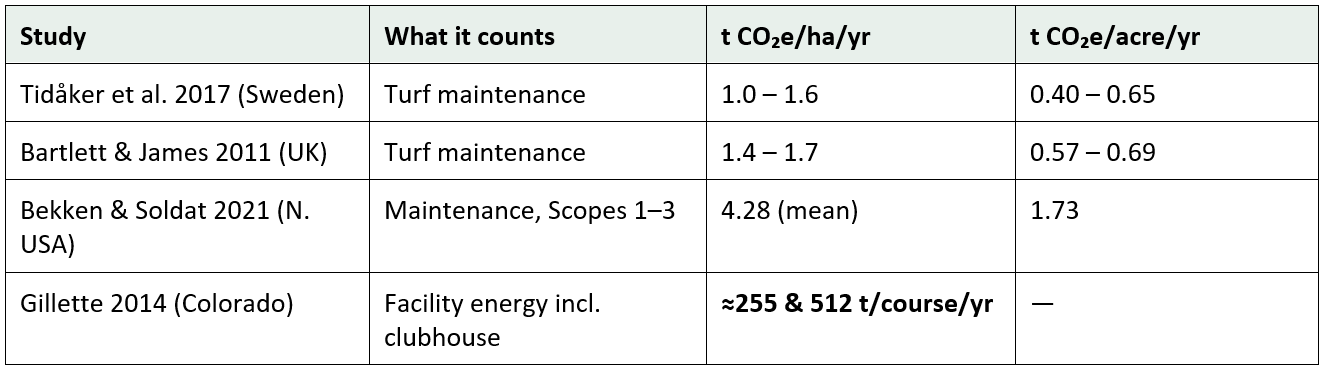
Figures as published; per-acre conversions at 1 ha = 2.471 acres. Gillette's figures are absolute facility energy, not area-normalized.
The spread across the first three rows is mostly scope and electricity mix. Tidåker et al. (2017) measured two Swedish courses on a grid dominated by hydro and nuclear and excluded upstream materials that Bekken included. That study also gives the most useful internal breakdown available: emissions per unit area were highest on greens, then tees, fairways and roughs (though in total, fairways and roughs comprise the most acreage and thus the largest overall maintenance footprint).
The Catch: Carbon Sinks Saturate and Mature
The other major nuance to update since our 2022 article involves what happens below ground.
Turfgrass can store significant carbon in soil, particularly when established on land with depleted soil-carbon stocks. But that process does not continue at the same rate forever. A 2023 meta-analysis of 63 turfgrass datasets found that turf established within the previous ten years accumulated soil carbon equivalent to an average 5.3 t CO₂/ha/year. The rate generally decreased as turf aged, and the cross-study mean was no longer statistically different from zero at around 50 years. The same analysis estimated that mowing, nitrogen-fertilizer production and soil N₂O emissions offset roughly 32% of carbon accumulation in recently established fertilized turf.
Golf-specific work finds the same arc. Bekken and Soldat report that courses are commonly carbon negative (sequestering more than they emit) for the first 25 to 30 years after establishment, then turn carbon positive as emissions hold steady while soil sequestration slows. Selhorst and Lal found the same pattern across eleven Ohio courses, with the flip around year 30.
This distinction between carbon stock and annual carbon sequestration is critical, and it is where our 2022 thinking was loosest.
A golf course's soil is a savings account that fills up. Its emissions are a standing monthly expense. The first is finite. The second continues to accumulate unless checked.
Bekken and Soldat used previous soil-carbon models to estimate that an average northern U.S. course with 38 hectares (about 94 acres) of maintained turf, converted from agricultural land, could accumulate roughly 6,000 metric tons CO₂e in its soils over its life. Spread across a hypothetical 200-year lifespan, that storage capacity would support an average emissions budget of approximately 30 t CO₂e per year, or 0.79 t CO₂e/ha/year, if turf storage alone were expected to balance maintenance emissions across the whole period.
That 0.79 figure is not a typical annual sequestration rate. It is better understood as a long-run emissions ceiling implied by that particular lifecycle model. Measured against it, current maintenance emissions in the study ran about five times higher. Bekken's own framing of the finding is blunt: emissions need to come down by more than five times for the lifecycle to balance on turf carbon alone.
More recent research reinforces the uncertainty rather than resolving it. Bekken, Gregg Sanford and Soldat sampled two courses in the UK and found substantially more soil organic carbon than in neighboring agricultural fields (differences corresponding to about 0.41 and 0.77 Mg C/ha/year when divided by course age, or roughly 1.5 and 2.8 t CO₂/ha/year). They deliberately call this counterfactual carbon storage rather than measured sequestration, because nobody observed those soils continuously from construction to the present. Their conclusion is that emissions reductions, not sequestration, determine whether a course is carbon neutral across its lifecycle. A University of St Andrews report commissioned by The R&A in November 2025 also found that the golf courses of Scotland, England and Wales collectively hold a significant national store of soil carbon, and that area for area, they hold more than UK arable farmland.
Golf land, in other words, often compares favorably to what surrounds it (which is a different and more defensible claim than golf being a carbon sink in absolute terms). That is exactly the kind of nuance regenerative golf needs. We should be interested in carbon. We should also resist pretending we can measure absolute values of a living system, and should only measure with the precision that evidence allows.
Nitrous Oxide: The Even More Invisible Greenhouse Gas
If carbon is the headline, nitrogen is the story underneath it. In the Swedish study, fertilizer-related emissions (manufacturing plus soil nitrous oxide after application) accounted for 50 to 58% of fairway emissions and 41% of tee emissions, with mowing making up most of the balance. Nitrous oxide is over 265 times more potent than carbon dioxide over a century as a greenhouse gas, so a small mass of it goes a long way on the scorecard. Those same researchers flagged N₂O from decomposing grass clippings as a potential hotspot needing further investigation, which is a good reminder of how unsettled this area still is.
The obvious question is whether integrated turf management and healthy soil amendments could take nitrogen to zero. Likely not on the playing surfaces, and the reason is a mass balance rather than a philosophy. Clippings are removed from greens, sand rootzones hold almost no nutrient reserve by design, and recovery from ball marks and wear requires growth. Nordic demand-driven fertilization trials put the floor at roughly 3.1 to 3.5% leaf nitrogen, below which bentgrass greens showed fungal damage and thin shoot density they did not fully recover from the following spring.
But the gap between typical and necessary is wide, and that gap is where the emissions savings live:
Match rate to demand. Estimating nitrogen from clipping volume and tissue nitrogen ties inputs to actual plant uptake/consumption.
Choose the species for the job. Fine fescues have produced acceptable putting surfaces at a fraction of the nitrogen creeping bentgrass requires, with little or no dollar spot at low rates. Another nuance: grass selection is specific to context and bioregion.
Let the rough fix its own. Legume inclusion in out-of-play and low-fertility areas can supply meaningful nitrogen without fertilizer, although fixation falls as applied nitrogen rises.
Regenerative air management does not mean eliminating nitrogen. It means matching nitrogen to demand on the playing surfaces while designing the rest of the property so it fixes its own.
Letting the Ground Breathe
There is a paradox at the core of this topic of regenerative land management. In regenerative agriculture, building soil organic matter is the goal: less disturbance, deeper roots, more carbon, more depth. On a putting green, organic matter is managed down (often diluted with sand topdressing and vented through aeration) because accumulated organic matter seals the surface, holds water and costs you firmness and infiltration. The most intensively managed ground on the property is deliberately worked against carbon accumulation. In other words, a golf course (even a regenerative golf course) isn't a cow pasture.
Is that environmental heresy? More like zoning and thoughtful landscape design. Greens are a small fraction of the acreage, and they are the part that requires “breathing” in the agronomic sense. The carbon story belongs to the other 95% of the property.
The encouraging development is that doing less of the traditional disruption may be viable. USGA work on standardized organic matter testing found one course near the lowest organic matter levels in the dataset that had not core aerated in six years, relying on solid tines and sand instead. The authors concluded that nitrogen rate and sand topdressing frequency drive organic matter far more than coring does. Lower nitrogen means less organic matter to remove, which means less disruption for golfers — an agronomic, emissions and member-satisfaction win in a single decision.
Drainage deserves the same double reading. In the rootzone, drainage is what lets soil breathe, since waterlogged soil pushes out air and suffocates roots. At landscape scale, drainage of organic soils is a carbon leak, but on putting surfaces it may be a necessary trade-off. Draining the greens keeps the landscape playable and functional for its purposes. STERF's robotic mowing research adds a third angle: small electric robotic mowers produced turf quality comparable to or better than traditional mowing in Nordic trials, with lower broadleaf-weed coverage, and Fairways4Future reports a clear tendency toward lower soil compaction under robotic mowing, along with no clippings left on the surface and clear edge definition after one season. Less compaction means better gas exchange and all-around nutrient exchange, and robotic mowers enabling more frequent mowing could keep surfaces tidier while even boosting sequestration rates.
The Ecological Design Thesis
This leads to what may be the more interesting opportunity. Golf isn't simply a grassland, as we have described it in past articles. A golf course is a tapestry of trees, tees, greens, fairways, roughs, native vegetation, wetlands, water, buildings, roads and other infrastructure. Recent U.S. golf industry land-use data from GCSAA report roughly 95 acres of maintained turfgrass and 23 acres of natural areas at a typical facility, including about 49 acres of rough against only 27 acres of fairway and three acres each of greens and tees.
See: GCSAA Golf Course Environmental Profile land-use report
Not every acre needs to perform the same job. Greens need to roll well. Fairways need to provide predictable playing surfaces. But what does an out-of-play acre need to do? If an acre contributes little to golf strategy, it may be worth more as meadow, native rough, woodland, savanna, riparian habitat, productive permaculture and/or agroforestry than as intensively maintained turf.
Naturalization: Passive Option
Naturalization reduces emissions by eliminating unnecessary mowing, irrigation and inputs, and it does so while saving money. USGA-supported economic research estimated that facilities adopting naturalized rough reduced annual maintenance expenditures by about 7.6%, or roughly $71,000 per adopting facility in the model, before implementation costs, with labor representing the majority of the savings. The honest caveat is that the carbon value of unmanaged areas is poorly measured; reviews of turfgrass carbon note that the sequestration potential of naturalized roughs remains largely unknown. Low emissions are certain. Sequestration is plausible but unproven (and research suggests that actively managed acres can sequester at faster rates than unmanaged).
Productive Agroforestry: Active Option
Other areas can be designed as more active carbon sinks. Temperate agroforestry research generally finds greater soil organic carbon under systems such as hedgerows and alley cropping than comparable treeless agricultural land — one meta-analysis estimated average soil carbon accumulation across the upper 40 centimeters at roughly 0.36 t C/ha/year, about 1.3 t CO₂/ha/year, without counting carbon stored in woody biomass. Check out our article on agroforestry to consider implications for golf design.
Actively regenerating woody systems accumulate much faster during certain stages. A long-term southeastern U.S. study estimated total ecosystem accumulation of 1.81 to 2.26 t C/ha/year, roughly 6.6 to 8.3 t CO₂/ha/year across biomass and soil, over about 70 years of forest regeneration. That should be treated as an upper-bound ecosystem analogue rather than an assumed rate for golf course agroforestry, since geography, prior land use, species, soil, water, disturbance and age all matter enormously. But it demonstrates the biological potential of out-of-play land: thirty acres performing near that high-growth range could theoretically remove around 80 to 100 metric tons of CO₂ per year during active regeneration, bringing total golf facility sequestration rates well above historically measured values.
Suddenly, the land that golf maintenance does not need to mow becomes strategically important.
Designed as a gradient, this is also good architecture: a mown, ball-visible rough; a multistrata buffer of canopy and shrub layers behind it; deep-rooted plantings along drainage and riparian corridors; and tended, productive planting at the boundaries where members and neighbors see it. One agronomic constraint applies throughout: keep the canopy away from greens and tees, where shade and restricted airflow weaken turf and raise disease pressure. Air circulation above the surface and carbon storage in the margins have to be designed together, and designed within other constraints of SWALE (Soil, Water, Air, Life, and Energy).
Turning “Waste” into Stored Carbon
The loop that ties the two halves of the property together runs on the course's own organic streams. Collect the clippings, leaves, buffer prunings and clubhouse food waste. Compost the soft material and pyrolyze the woody prunings into biochar, ideally co-composting the two. Then return the product: heavy applications out of play, light topdressing where it suits the playing surfaces. Evidence to be explored in a later SWALE series post.
Reduce the Source Before Maximizing the Sink
Ecological design should not become an excuse to maintain an inefficient operation. The first goal is still to push the operating footprint down, and because fuel and electricity accounted for 63% of maintenance emissions in the northern U.S. sample and fertilizer roughly half in Sweden, the agenda is short and unglamorous:
Electrify mowing and transport equipment at the normal replacement cycle, rather than scrapping working machines early.
Source low-carbon electricity. On a high-carbon grid, electrification relocates emissions instead of removing them.
Improve pumps, irrigation scheduling and soil-moisture management, and reduce irrigated and mown acreage.
Match nitrogen applications to plant demand and manage N₂O risk (Tidåker's authors identify fairway nitrogen as the highest-priority lever).
Source sand and materials efficiently, extend machinery life, and select cultivars that deliver the desired conditions with fewer inputs.
Address the clubhouse. If it represents the majority of facility energy emissions, efficiency, heat pumps and clean power there will outweigh everything done on the course.
Protect what is already stored: avoid draining organic soils, avoid clearing woodland for turf, and design renovations for minimal disturbance.
Using the northern U.S. maintenance inventory as a starting point, an aggressively optimized course might plausibly move its maintenance footprint from roughly 153 t CO₂e/year toward only a few dozen tons through electrification, renewable energy, reduced mowing acreage, lower fertilizer demand and lower material inputs. A working operating floor of 30 to 60 t CO₂e/year is useful as an engineering scenario. It is not yet an observed industry benchmark, and that distinction matters.
Can Golf Become Carbon-Regenerative?
Yes! Under the right conditions.
Consider the two sides together (sources and sinks). If a highly efficient facility can reduce controllable annual operating emissions toward 30 to 60 t CO₂e, while 30 acres of actively regenerating woody habitat temporarily remove something on the order of 80 to 100 t CO₂ per year, the property becomes a meaningful net carbon sink before counting any additional soil carbon accumulating beneath its maintained turf.
That does not mean every course can reach those figures, and it does not mean the sequestration rate stays that high forever. As forests, turf and soils mature, annual accumulation slows. Permanence therefore does not come from assuming nature will absorb an ever-growing amount of carbon. It comes from using the high-growth years to build durable carbon stocks while continually reducing the carbon required to keep the property functioning. In practice, a regenerative golf course also staggers new plantings so that the property always holds a portfolio of sinks at different ages. The goal is for the mature landscape's remaining annual sequestration capacity to stay above the course's residual emissions.
A carbon-regenerative golf course is one where verified annual onsite removals exceed the residual emissions required to operate the facility, while those carbon stocks are protected over time and playability remains commercially sustainable.
Carbon neutrality, in that framing, becomes the threshold rather than the destination. Three qualifications keep the claim defensible:
Most of the carbon in a woody sink sits above ground, where storms, fire, pests and vegetation removal can reverse it in a season, which is a live consideration in hurricane-exposed regions.
The claim covers operations rather than the sport, since on-site sinks are unlikely to absorb construction and golfer travel.
Nearly every figure in this article comes from cool-season courses in the northern United States and northern Europe; nobody has published equivalent benchmarks for warm-season courses in the American South, where growing seasons, grasses, nitrogen cycling and grid mix all differ. Treat these ranges as directional outside northern climates, and treat that gap as an invitation to the research community.
Playability Is Part of Permanence
That last condition deserves its own section, because an environmental purist might reasonably ask why playability should constrain any of this.
Golf landscapes were not created to be carbon sinks. They were created to play golf. Carbon stored in a landscape is only as durable as the land use protecting it: if a course fails commercially, the land does not revert to prairie. It is far more likely to become housing and pavement, which releases the stored carbon and forecloses the future sequestration. Keeping the course playable is what keeps it operating, and operating is what keeps the carbon in the ground. The carbon strategy and the business strategy are the same strategy.
So regenerative design asks a different question than “how much carbon can we store?” It asks how intensely we actually need to manage each acre to deliver excellent golf. The answer differs for a green and a rough, for Florida and Iceland, for a course built on degraded agricultural soil and one sitting over drained organic soil. Ideally, out-of-play areas either reduce operating costs through naturalization or generate their own return through products and services. That is where a specialist operating partner can carry the added maintenance intensity rather than the golf operation absorbing it (as we have discussed before).
What to Measure
Regenerative claims are only as good as the measurement behind them, and verified removals are the standard we set above. A practical starting set:
Rootzone: organic matter in the top 0–2 cm, infiltration rate, rooting depth.
Emissions: fuel and electricity per maintained hectare, nitrogen applied per unit area, clubhouse energy.
Carbon stock: soil organic carbon by management zone at a fixed depth, resampled every three to five years using a published method such as Bekken, Sanford & Soldat's two-tiered approach.
Land: acres by management intensity, acres on drained organic soil, acres rewetted, and a tree inventory for woody biomass.
Waste Reclaimed: tonnes of compost and biochar applied with carbon content, and the share of on-site organic waste returned to the land.
Playability: firmness and green speed consistency, rounds played, member satisfaction.
Conclusions: Golf Can Go Low on the Carbon Scorecard
Rates of emissions and sequestration at any given course will change over time depending on a number of factors:
Age of the course
Fuel and electricity sources
Geography and bioregion
Site origins
Design of its multi-functional areas
Whether it keeps running at all!
Evidence supports that a mature golf course is typically a modest net carbon source, its soils having already banked most of what they will hold. Its maintenance emissions are dominated by fuel, electricity and nitrogen, and its clubhouse is probably the larger half of the problem. Its out-of-play land is the one place where the balance can be meaningfully changed. Reducing the footprint while engineering the sinks means a carbon deficit above ground and a carbon surplus below it.
Carbon also cannot become the only environmental scorecard, nor should we think that carbon is the most material risk for a golf course. A golf course could theoretically optimize carbon while doing a poor job managing water, nutrient leakage, erosion or biodiversity. For most facilities, those are the bigger priorities and the ones more likely to determine whether the course keeps its social license in its own watershed. That is why Air belongs inside SWALE rather than standing alone.
A thoughtfully regenerative golf course balances Soil, Water, Air, Life and Energy as one interconnected operating system, providing playable golf alongside ecological value and ecosystem services in service of people, planet and profit, or in our terms, business, biology and being. The aim is not simply the lowest possible carbon number. It is to create enduring, playable golf that increases the ecological and economic value produced by the land. If we can reduce the atmospheric cost of keeping golf playable while designing the rest of the property to actively regenerate, golf might do more than reach “scratch” (net zero). It can go under par on the carbon scorecard.
Key Sources
Austin, Smeaton, Flynn & Macdonald (2025), UK: Soil Organic Carbon Storage in Coastal Golf Courses; a University of St Andrews report commissioned by The R&A under Golf Course 2030; UK golf courses hold more soil carbon per unit area, on average, than UK arable farmland, and those stores are vulnerable to coastal erosion from accelerating sea-level rise.
Bekken & Soldat (2022), Northern USA: Estimated energy use and greenhouse gas emissions associated with golf course turfgrass maintenance in the Northern USA; 14 courses over three years; 4.28 t CO₂e/ha/yr across all scopes; 153 t/course/yr; fuel and electricity 63%; the 25–30 year carbon crossover and the 6,000 t soil storage model.
Bekken, Sanford & Soldat (2025): Next steps toward improving estimates of golf course net climate impact; a two-tiered soil carbon methodology for individual courses; 0.41 and 0.77 Mg C/ha/yr of counterfactual storage.
Phillips et al. (2023): Turfgrass carbon meta-analysis; 63 datasets; 5.3 t CO₂/ha/yr in the first decade, declining to no different from zero by 50 years; management offsetting ~32% of accumulation.
Tidåker, Wesström & Kätterer (2017), Sweden: Energy use and greenhouse gas emissions from turf management of two Swedish golf courses; 1.0 and 1.6 t CO₂e/ha/yr area-weighted; fertilizer 50–58% of fairway emissions; the clipping N₂O hotspot.
Gillette (2014), Colorado: The Colorado Golf Carbon Project; facility energy including clubhouses, maintenance buildings and irrigation pumping.
Roald & Guðmundsson, STERF: Can golf courses store carbon? and the Carbon Par project page; mineral versus drained organic soils, and drained wetlands as an unintended emissions source.
STERF ROBO-GOLF and Fairways4Future; robotic mowing, turf quality, weed coverage and lower soil compaction.
Thompson, Kridel & Kenna (2022): Economics of naturalized rough; about 7.6% lower annual maintenance expenditure, roughly $71,000 per adopting facility in the model.
Braun et al. (2023): Strategies for reducing inputs and emissions in turfgrass systems; practitioner-facing synthesis of the crossover findings and electrification trade-offs.