Engineering, Intuition, and the Future of Turf
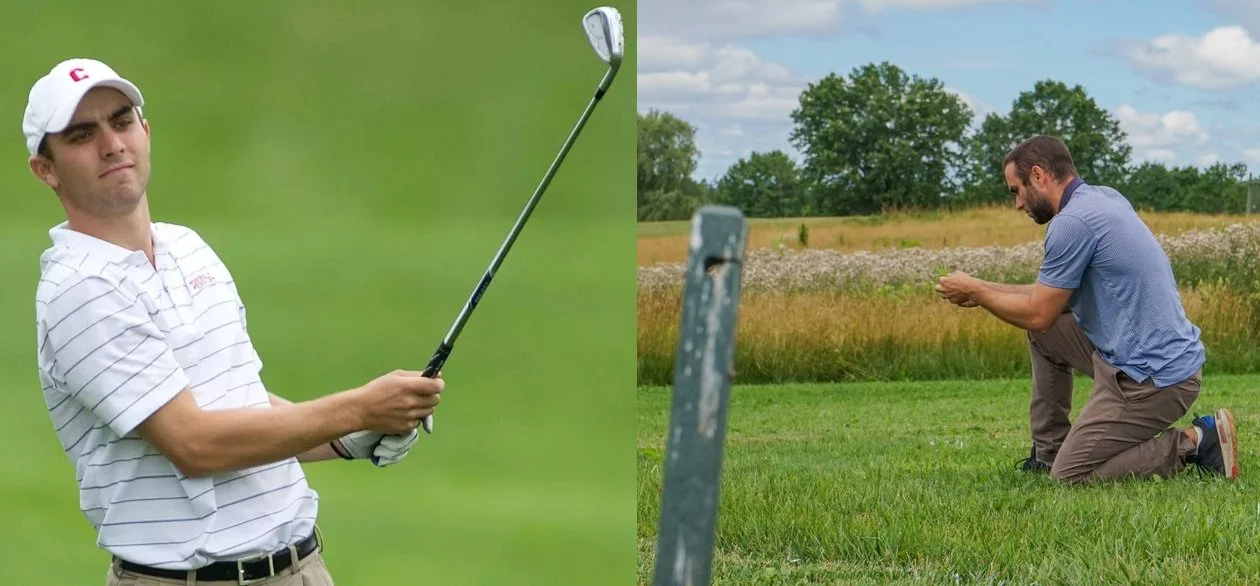
Carl Schimenti, Urban Environmental Specialist for the Cornell Turfgrass Team
A Conversation with Carl Schimenti (Cornell Turfgrass Team)
Note: this transcript comes from a 40-minute conversation and was condensed into paraphrased content through the help of large language models (LLMs). Final edits of the transcript have been approved by Carl.
What does playing great golf share in common with stewardship of healthy and sustainable turf?
The following conversation with Carl Schimenti came from a recommendation of bio-neer Dr. Rebecca Nelson who we interviewed back in 2022 about pee-cycling as a cost-effective approach to address fertilization and waste management. Carl and I connected back to that topic briefly, but we spent most of our time discussing the very practical balance between systematic measurement and tactical feel, or between theory and application when it comes to turf management.
“A model might say there’s a 63% chance you win if you go for it on fourth and two. But the model doesn’t know if your left guard is hurt, the field is wet, or your quarterback can’t sneak.
Those real-time factors are inside the “black box” of complexity. That’s where human intuition still matters. Superintendents are very good at understanding those margins — the things we can’t realistically model.
The goal isn’t to eliminate intuition; it’s to inform it.” — Carl Schimenti
Carl frames science & data as “guidance, not prescription” throughout the discussion. We explored how information-sharing and storytelling can create positive frameworks around innovative green tech and management practices such as pee-cycling, biochar, and precision technologies.
With that, we hope you enjoy our conversation!
Andre Paul (Driving the Green):
Carl, it’s great to finally connect! You came highly recommended by Rebecca Nelson, and what immediately stood out to me is the rare intersection you inhabit: deep engineering and agronomic expertise, hands-on turf research at Cornell, and a genuine love of the game of golf itself.
I’d love to start at a first-principles level. From your perspective, what do engineering, golf, and responsible turf management all share at their core?
Carl Schimenti (Cornell Turfgrass Team):
What originally drew me to golf is something that mirrors engineering and turfgrass almost perfectly. Golf can be incredibly complex if you want it to be — swing mechanics, ball flight physics, green speeds, agronomy — but at the end of the day, it’s also incredibly simple. You count strokes on a scorecard.
That same tension exists in engineering. When I was an undergraduate studying engineering, you could make problems incredibly complex, modeling every possible variable such as biological oxygen demand in water quality, nutrient cycling, and hydrology …or you could pull back and use a much simpler set of equations that still give you a very good estimate of the outcome.
Turfgrass is the same way. You can dive deeply into soil physics, disease pressure models, pesticide risk matrices — or you can step back and ask some very basic questions: How much water are we applying? How much fertilizer? What pesticides are being used? And how do we define success? Is it green speed? Rounds played? Revenue?
You could think of it as a “black box” approach. You draw a box around all the complexity, and you focus on what’s going in and what’s coming out. You need the ability to move fluidly between those levels — zooming out to the 10,000-foot view, then zooming in when necessary.
That’s what I love about golf, engineering, and turfgrass management. They all allow you to toggle between simplicity and complexity depending on the problem you’re trying to solve.
Andre:
That really comes through as systems thinking. I want to improvise one quick rapid-fire question here… as a golfer, are you more of a “feel” player or a “systems” player?
Carl:
It’s definitely a mix. When I played more competitively in college, I tried to be very mechanical and systematic, which makes sense coming from engineering, where there’s always a right answer.
Over time, I’ve held onto the data side. I track my scores, my practice sessions, trends in my game. But when I’m actually playing, I have to let that go. Once you’re on the course, it becomes about feel.
You might know where you normally aim with no wind, but maybe today your body feels a little off, or your miss is trending right. That’s not something a spreadsheet can fully capture in the moment. So when I play, it’s more feel-based. Then afterward, I go back to systems thinking to plan how to improve.
Andre:
That balance feels so relevant to agronomy as well. How do you personally bridge the gap between theory and execution in turf management?
Carl:
That’s a huge part of my job as an extension specialist. We spend a lot of time educating superintendents on best management practices — what the science says is ideal.
But every golf course is unique. Soil types, microclimates, traffic patterns — none of that exists in a textbook. So I try to frame science as guidance, not prescription.
Take irrigation and evapotranspiration (ET) data as an example. We know that if you let a computer tell you exactly when to irrigate, you can reduce water use by about 20% compared to a schedule-based approach. But that doesn’t mean the computer should make the decision for you.
Instead, you use the ET model to understand when irrigation might be needed, then you go out, look at soil moisture, feel the turf, talk to golfers, and decide whether it actually makes sense to turn the system on — and which heads to use.
The grass doesn’t read the textbook. The theory informs your judgment, but it can’t replace it.
Andre:
That reminds me of sports analytics — like going for it on fourth down because the model says it improves your win probability.
Carl:
Exactly. A model might say there’s a 63% chance you win if you go for it on fourth and two. But the model doesn’t know if your left guard is hurt, the field is wet, or your quarterback can’t sneak.
Those real-time factors are inside the “black box” of complexity. That’s where human intuition still matters. Superintendents are very good at understanding those margins — the things we can’t realistically model.
The goal isn’t to eliminate intuition; it’s to inform it.
Andre:
That brings us naturally to AI. What do you see as the developing role of AI in turf management?
Carl:
When I think about AI’s real impact in turf, my mind goes first to remote sensing and precision technologies — not large language models.
Agriculture has been using these tools for years. Think of cameras mounted on tractors that detect disease on individual grape clusters or apples, then trigger sprayers to apply product only where needed. That kind of “see and spray” technology can reduce pesticide or fertilizer use by 80–90%.
Those tools are just now becoming viable in turfgrass, and they’re especially promising because turf is relatively homogeneous. Disease and weed detection can be very effective.
To me, that’s the most immediately impactful application of AI — site-specific, precision turf management.
Large language models can help with documentation, training manuals, onboarding seasonal staff — and that has value. But compared to reducing chemical inputs at scale, that impact is relatively small.
Andre:
Are superintendents adopting these technologies?
Carl:
Not yet at scale. In a recent survey of New York superintendents, only about 2–3% reported using remote sensing — which is pretty much what we expected.
Adoption isn’t just a technology issue; it’s a behavioral one. Trust is a big barrier. Superintendents are trained to know every inch of their course. When a sensor tells them where to spray, there’s a fear that it’s replacing their judgment.
There’s also a budget dynamic, especially at private clubs. In many cases, if you don’t spend your full budget, you lose it. So saving money isn’t always the incentive we think it is.
Ironically, public courses might benefit the most. If you can use precision tools to treat 2 acres instead of 30, suddenly targeted applications become affordable where they never were before. But public courses also face the biggest hurdles in making upfront investments.
Andre:
New York seems to be showing leadership here. Can you share what’s been working?
Carl:
One of our biggest success stories has been an Environmental Results Program (ERP) we ran with about 200 golf courses across central and western New York.
We surveyed a representative sample, identified which BMPs weren’t being adopted, then built highly targeted education around those gaps — webinars, podcasts, physical mailers, drought plans, online handbooks.
Two and a half years later, we re-surveyed and saw real movement: increased use of soil moisture meters, better nutrient management at wash pads, improved clipping management. It validated that extension can work when it’s focused.
We also learned something important: framing matters. Superintendents care about environmental stewardship, but they care even more about turf quality and golfer experience.
When we said, “Use less water because it protects water quality,” that helped. When we said, “Use less water because your greens will be firmer, faster, and healthier,” adoption skyrocketed.
Andre:
Let’s talk about golf design. Where do you see sustainability challenges from a design perspective?
Carl:
One of the biggest issues is bunkers. USGA data shows that the cost per acre to maintain bunkers is essentially the same as greens.
When I see courses with four or five bunkers per hole, I ask: are they all really intentional? Many are aesthetic rather than functional, and they create pace-of-play issues for average golfers.
Fairway acreage is another big driver. Fairways consume the majority of water, fertilizer, and pesticide use simply because of their scale. Wider fairways may help higher-handicap players, but they dramatically increase resource use.
I’m not saying we can’t have these features — but we should be much more deliberate. Cool features are fun to play, but they’re expensive to maintain. The question is whether they’re still viable 30, 50, or 100 years from now.
Andre:
Are there any emerging technologies that really excite you?
Carl:
Honestly? Urine.
Rebecca Nelson brought this idea to us, and at first it sounded ridiculous. But we tested human urine against synthetic urea, and it performed essentially the same.
Urine is about 1% nitrogen. It’s free, ubiquitous, and currently treated as waste. If we can divert it from septic systems — especially in places like Long Island with vulnerable aquifers — and apply it to turf where plants can actually use it, the implications are huge.
Rebecca is even working on urine-charged biochar, which could be applied granularly. If this scales, it could drastically reduce the need for synthetic fertilizers and the energy required to produce and transport them.
That kind of solution completely reframes how we think about golf courses — not as environmental liabilities, but as part of nutrient cycling systems.
Andre:
How do we responsibly scale ideas like this? Do you have a perspective on experimental design? Are pilot projects the key?
Carl:
Through case studies. Real-world pilots and sometimes even whole-course adoption.
That’s why we do more research on actual golf courses now than on research plots. When superintendents see someone they trust using a practice successfully — especially “keystone” superintendents — adoption accelerates.
Grass is easy to study. People are not. Behavioral economics matters as much as agronomy.
Andre:
That feels like a perfect place to land. Carl, thank you for your time and your thoughtfulness. Conversations like this are exactly why Driving the Green exists.
Carl:
My pleasure. Happy to help move the conversation forward.