
Pondering Pond Quality & Holistic Turf Health
A Conversation with Ron Pote, NanoOxygen Systems
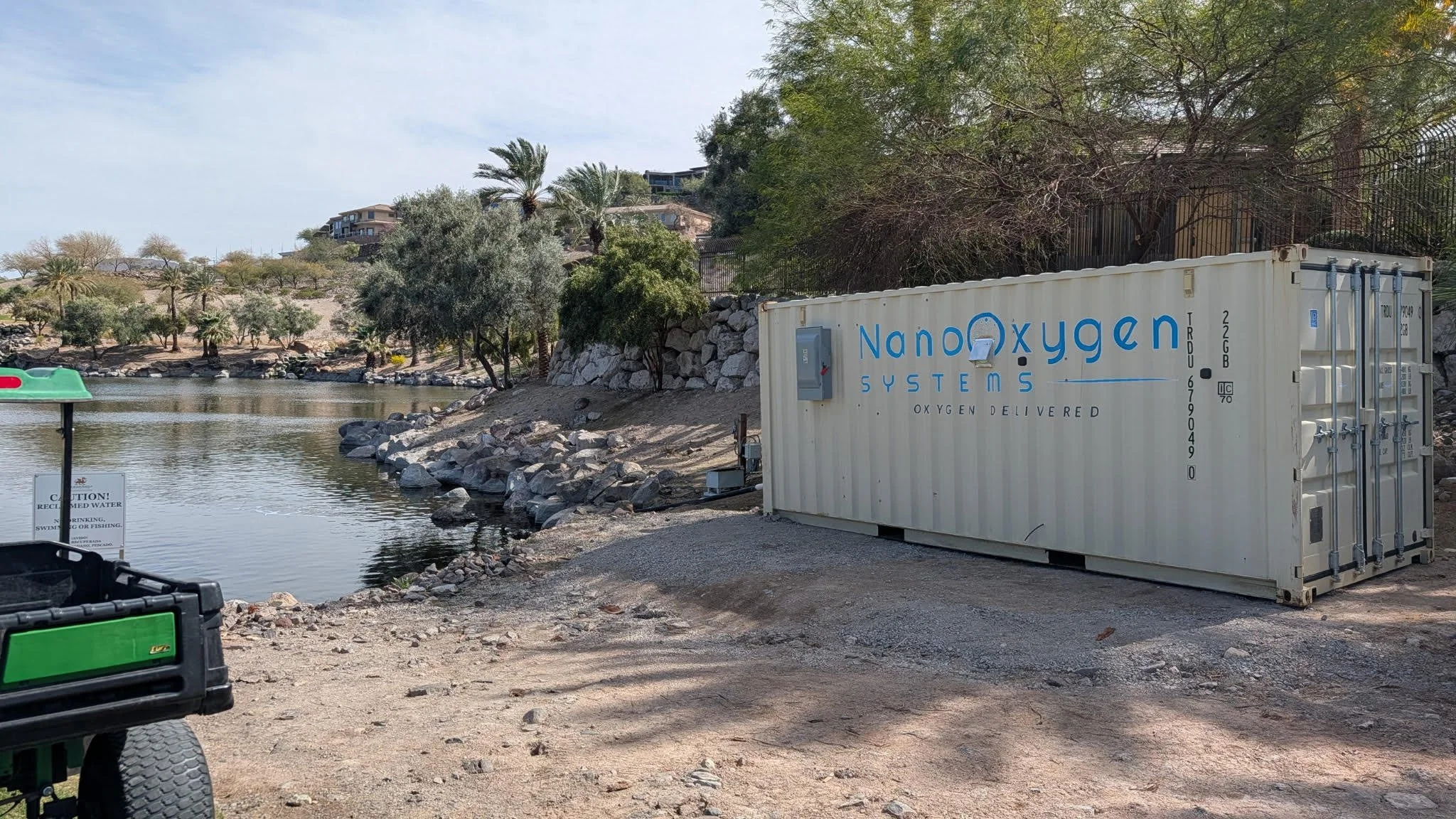
NanoOxygen Systems technology in action
Turf is a living system.
All living systems either thrive, decline, or merely “survive” in response to how we treat the foundations. In both western agronomy and western medicine, the dominant paradigm has often been symptom-first. See a problem. Apply a product. Suppress the issue. Move on to other problems. Sound familiar?
Western medicine has been criticized for being:
Expensive
Reactive rather than preventative
Over-reliant on chemicals
Incentivized around treatment instead of true health
…and yet, we’re grateful it exists when emergencies arise!
The same tension exists in turf management.
For decades, the golf industry has leaned heavily on chemistry. If there’s algae, spray it. If there’s disease, treat it. If there’s a turf decline, apply another input. But what if many of these symptoms originate from something more fundamental?
Water.
NanoOxygen Systems approaches golf course management not as a chemistry problem, but as a biological systems problem. Their technology focuses on improving dissolved oxygen, stabilizing irrigation water, and restoring foundational conditions that allow soil biology and turf to thrive.
Rather than masking symptoms, the goal is to improve the environment in which turf grows. NanoOxygen’s products have proven that you can reduce chemical dependency while improving playability and the quality of golf. Thanks to our mutual connection Jim Ireland (Nicklaus Green), I recently sat down with NanoOxygen founder Ron Pote to discuss water quality, irrigation, and what it truly means to manage turf holistically.
One theme emerged repeatedly:
Healthy living systems, whether human or ecological, share common principles.
With holistic, preventative care:
The foundations often cost little (or pay for themselves in little time)
Root causes are addressed so that symptoms dissipate sustainably
Chemicals are applied only when necessary
Profit aligns with improving overall life quality
Emergencies become less frequent
In this conversation, Ron shares how a crisis at East Lake Golf Club (host of the Tour Championship) became a proving ground for rethinking irrigation water entirely.
As Ron puts it:
“This is not just selling a piece of equipment; it is selling a fundamental shift in how a golf course manages its largest input, which is water. That mindset shift is what takes time.
…
It’s not just about ponds. It’s about water as the foundation of agronomy.
Fix the water, and you fix a lot more than people realize.”
– Ron Pote
On that note, we hope this conversation inspires you to rethink paradigms about turf along with realizing the returns! In multiple cases, Ron’s technologies have been shown to reduce golf facility water and chemical expenses by over 40% annually.
Andre Paul in Conversation with Ron Pote of NanoOxygen Systems
Andre:
One thing that connects Driving the Green with its readership and network is a shared passion for nature-based solutions and the game of golf. Before we even get into golf, what got you into water quality in the first place? And how did that eventually lead you into this industry?
Ron:
My background is water and wastewater. I worked for International Paper for 15 years in operations and environmental roles. We were located between New York and Vermont on Lake Champlain, so we had very high environmental standards. That experience really sparked my passion for water quality.
Later I started my own company focused on biological improvements in wastewater systems. I worked with municipal systems, paper mills, food processors, and others. I always leaned toward improving biology rather than just mechanical or chemical fixes.
At the same time, I’ve always loved golf. I kept seeing algae problems in irrigation ponds. They smelled bad. They were unsightly. The industry’s solution was usually chemical treatment.
I realized nobody was really addressing the root issue, which was water quality itself.
Where this really became clear was that the opportunity was not just to treat ponds.
Where you could really introduce this technology, where it could really help the industry isn’t just to treat the ponds, but to treat the irrigation water that’s going on the golf course.
That was the shift.
Andre:
Walk me through your work with East Lake Golf Club. Was this your first golf project?
Ron:
Yes. They had a sewage spill before the Tour Championship. Raw sewage got into the lake, and chemicals were dumped in to treat it. That created other issues, including copper contamination.
We initially installed a vendor-based nanobubble system. It was early-stage technology. It had mechanical problems. I was driving from Charleston to Atlanta constantly to keep it running. It was frustrating.
That forced us to redesign the system. We worked with Clemson University, tested oxygen and ozone integration properly, and developed a more reliable approach.
Once we installed that version, performance improved dramatically.
One moment that stuck with me was during a practice round. Tony Finau stopped and asked what I was doing. He said the place used to smell and now it didn’t.
That told me we were onto something. It was not easy. It was iterative. But it validated the concept.
Andre:
In other words, it sounds like East Lake was not an overnight success in terms of technology adoption and implementation; it was iterative as you say.
In scaling this technology, who tends to adopt first? What separates the superintendents who lean in (and stay in) from the ones who hesitate?
Ron:
It has absolutely been iterative. East Lake was not plug-and-play. We learned a lot there.
As far as adoption, there are really two types of superintendents. I call them sprayers and growers. The sprayers are chemistry first. If there’s a problem, they’re looking for the product to apply – because they were taught so. When superintendents understand the relationship of water quality to soil health, they lean more toward growers.
The growers are thinking about soil health, sustainability, and long-term system performance. At East Lake Golf Club, I got to meet Ralph Kepple as a visionary “grower” (who now works with us at NanoOxygen).
The early adopters are the growers. They’re already asking deeper questions about what’s happening in the soil and the water. They’re the ones willing to look at water quality as a lever for improving everything else.
Because this is not just about installing a piece of equipment.
It is promoting a fundamental shift in how a golf course manages its largest input they put on the golf course, which is their water.
That mindset shift is what takes time.
Andre:
So what does it take to scale this innovative approach to water and holistic turf quality? What are the biggest objections you hear?
Ron:
Education is the biggest hurdle.
Superintendents are not typically trained in water quality science in turf school. The industry has been chemistry-driven for decades, though I see that changing.
I’m a chemical engineer, so I understand what’s being applied to golf courses, but the instinct has been that if there’s a problem, you spray something. Many of the “sprayers” were never trained in water quality in turf school or they worked for someone who reinforced this approach, so part of the work is education. When they understand that oxygen in the irrigation water affects root health, nutrient mineralization, and overall turf resilience, that’s when the shift happens. Once they see it, they don’t go back.
Andre:
I would make the analogy that in Western medicine, doctors are often trained to treat symptoms with pharmaceuticals rather than address foundational inputs like nutrition or sleep. It feels similar in agronomy. When you talk about education as a key barrier in the turf industry, the “grower” approach seems to have parallels with Western medicine vs holistic or traditional approaches. Expand on that.
Ron:
It’s not unusual. If you look at the way Western medicine works, if you have a symptom, there’s a solution to that symptom, which typically is a pharmaceutical.
My daughter is a naturopathic MD. She would ask: what are you doing for exercise, for food, for nutrition? But traditionally trained doctors are often taught you have this problem and you apply this chemical.
I think some of that has happened in the golf industry.
When turf issues arise, the simplest solution is often to spray something… but what if water is the issue?
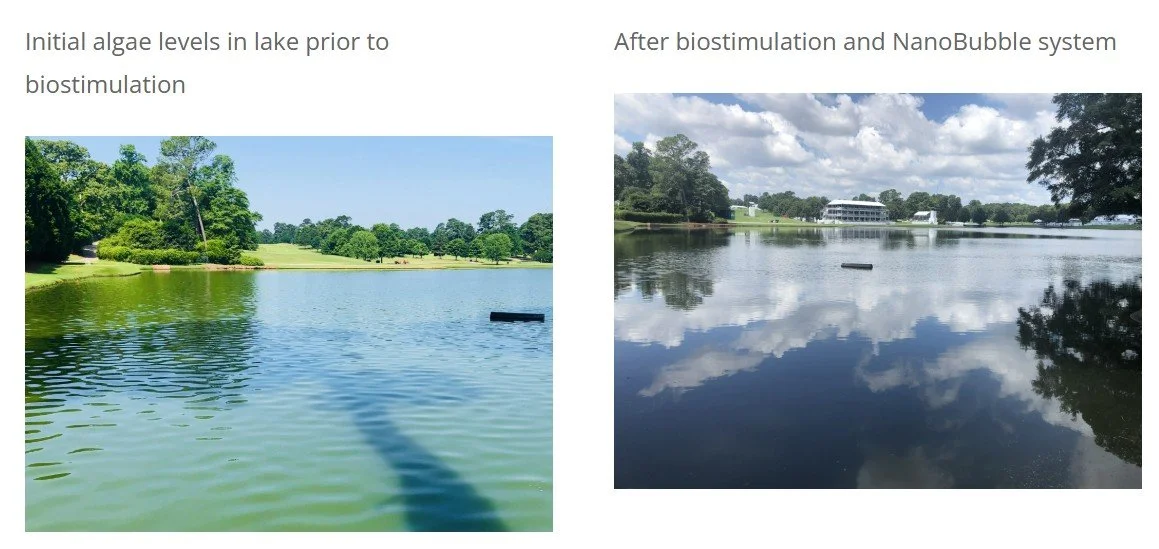
Before and After NanoOxygen Systems (Image via NanoOxygen Systems)

Andre:
Could you share what you have mentioned about why a golf course looks great after a nice rain?
Ron:
Yes. I ask superintendents that all the time.
What’s the golf course look like after a nice rain? Invariably it’s, “Well, the golf course looks beautiful.” And why is that?
Most people don’t have an answer.
It’s the oxygen in the water that does all that. Rainwater has an increased level of dissolved oxygen. Irrigation water often does not.
That simple example helps show how foundational water quality is to turf performance.
Andre:
Are there situations where this might not be the right solution? And how does it affect energy use, for example?
Ron:
It’s not a magic solution. It has to be designed properly. Our early work with vendor-based solutions failed. We had to engineer our own system using patented technology.
We generate oxygen and ozone on site. Oxygen is produced by removing nitrogen from the air and ozone by creating "lightning" in a unit. CO2 is the only gas we bring in when needed for pH control.
We are adding optimization tools to reduce energy and gas use.
From a financial standpoint, we’re typically seeing a 2-3 year payback based on chemical savings alone.
The bigger benefit, though, is improved turf quality (and happier golfers).
Andre:
We have also interviewed ECO2Mix before. They use carbon dioxide to create carbonic acid for pH control. How does your system compare?
Ron:
CO2 works! The issue is efficiency.
When you bubble CO2 into water with traditional methods, those bubbles rise and escape like in a glass of soda water. Our nanobubbles are non-buoyant, so all the CO2 we add gets converted to carbonic acid.
That makes pH control more efficient and less corrosive than traditional acid systems. We have systems installed at Walt Disney World for pH control. It can be roughly 20 percent of the cost of acid while avoiding corrosion and safety issues.
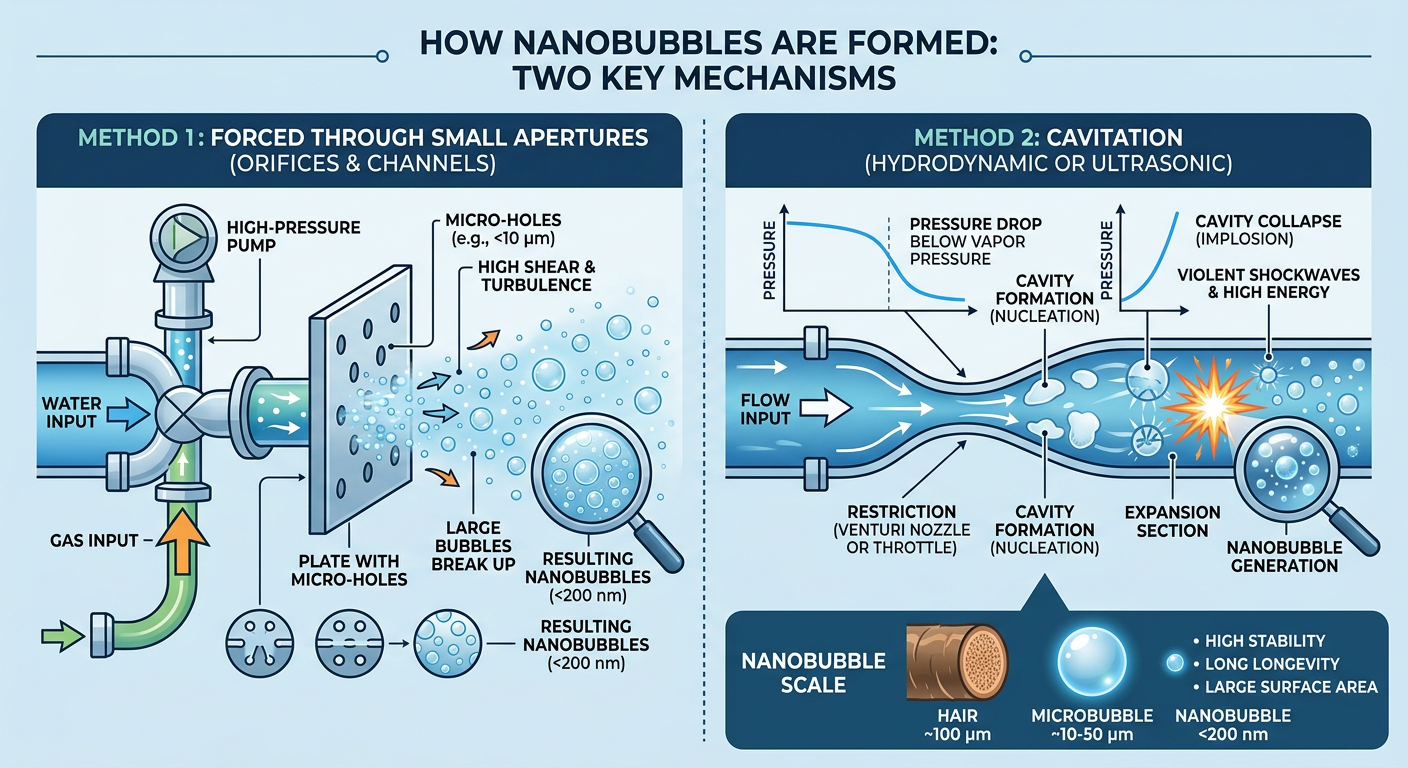
Image via NanoOxygen Systems
Andre:
One of the biggest issues in golf is access to reclaimed or remediated water. Does your system expand the ability to safely use those sources?
Ron:
Yes.
Reclaimed water often has higher organic loads. When it enters irrigation ponds, it consumes dissolved oxygen quickly. That leads to algae and poor soil outcomes.
By restoring dissolved oxygen and stabilizing the biology, we allow courses to use reclaimed water more effectively.
I visited a Caribbean course charging five hundred dollars per round. They had severe root issues that affected turf quality and playability. It wasn’t their agronomy program. It was their water quality.
Fixing the water would produce a dramatic change.
Andre:
Beyond turf performance, what positive externalities or fringe benefits have you seen?
Ron:
Pond odor elimination. Reduction in algae and cyanobacteria. Lower copper use. Reduced chemical dependency.
We also had a researcher from NC State doing nematode counts for some of our customer courses. He reported dramatically lower nematode counts and now is studying the microbiome of the plant to learn more about natural defense mechanisms.
The plants appear healthier and more capable of resisting pests naturally.
When you improve water quality, multiple downstream issues improve.
Andre:
On a final note, if you had to summarize what this solution represents for golf, what would you say? Who are the key stakeholders that need to be influenced and what do they need to hear?
Ron:
Superintendents are the key stakeholders. Many are looking to make their courses more sustainable and we've been able to offer them a way to do this that didn't exist 5 years ago.
It’s not just about ponds. It’s about water quality as the foundation of agronomy.
Fix the water, you improve the soil, and you fix a lot more than people realize.
Ron Pote, CEO and Owner of NanoOxygen Systems Discusses Sustainability in the Golf Industry